
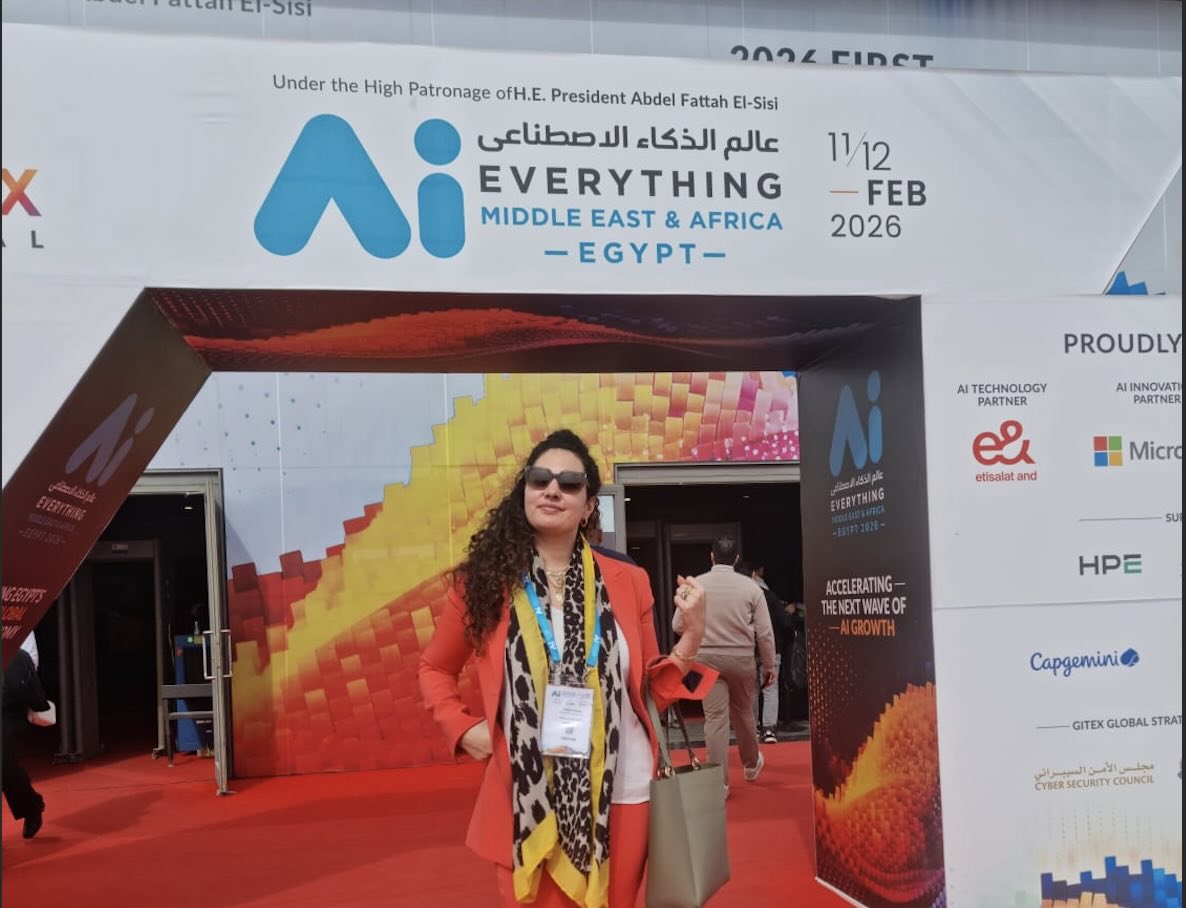
Egypt has set an ambitious benchmark for the decade: a projected $42.7 billion in AI-related economic value by 2030. However, as Rasha El-Shirbini, Founder of Social Jaguar, observed at the Ai Everything MEA Egypt 2026 summit in Cairo, the true narrative isn’t just about the figures—it is about a fundamental structural shift.
Held on the 11th and 12th of February at Egypt’s International Exhibition Centre, the event signaled that AI across the MENA region is transitioning from experimental pilots to core national infrastructure. For decision-makers, investors, and B2B marketers, this evolution presents a massive opening for local positioning and strategic marcomms.
1. AI as National Policy: The End of Hype-Driven Acceleration
A primary takeaway from the summit is that AI is no longer a peripheral innovation; it is a pillar of national security and economic policy. Egypt’s second National AI Strategy (2025–2030) is built on governance, data infrastructure, and talent development.
During a closed-door roundtable, Dr. Hoda Baraka (Advisor to MCIT), Eng. Mahmoud Badawi (Assistant Minister for Digital Transformation), and Dr. Michel Rogy (The World Bank Group) discussed how enterprises can scale AI-ready infrastructure to turn public-sector pilots into long-term economic value.
The Insight for Leaders: With global convergence around the OECD AI Principles and the NIST AI Risk Management Framework, governance is foundational. El-Shirbini notes that for these roadmaps to succeed, internal communication operations and educational campaigns will be vital to shift corporate mindsets.
2. Agentic AI and the Evolution of Enterprise Risk
The conversation has moved far beyond simple chat interfaces. Agent-based systems are now capable of autonomous monitoring, predictive adjustments, and risk-based escalation. This shift aligns with the risk-tiering seen in the EU AI Act.
Executives from Honeywell highlighted how autonomous systems are designed to improve efficiency while keeping humans in the loop for critical decisions. The level of human intervention now varies based on operational risk thresholds, from basic notifications to predictive alerts.
The Insight for Leaders: AI deployment must have embedded oversight and accountability mechanisms from the start. Documentation and internal training are no longer optional extras; they are core requirements for choosing the right tools in a saturated market.
3. Capital Discipline vs. The Branding Gap
As Ahmed Osama, Head of AI at Banque Misr, pointed out, the era of “blind investment” is over. In the MENA market, every AI initiative must now demonstrate a clear problem-solving capability and a measurable ROI to secure budget.
However, Rasha our founder identified one significant missed opportunity at the event that no one was talking about: storytelling and brand positioning. While giants like Cisco, Red Hat, Zoho, e& UAE, and Microsoft stood out, many other players blended into a “sea of blue and white” with overly complex messaging.
The Insight for Leaders: If your AI initiative cannot quantify value, it won’t survive the boardroom. But once the numbers are settled, strategic marketing is required to cut through the noise. There is a massive opportunity to provide ROI through brand clarity in sectors ranging from Agriculture to Biotech.
4. Infrastructure and Energy: The Quiet Constraints
While model efficiency is improving, energy consumption is a growing concern. Golestan (Sally) Radwan, Chief Digital Officer at the UN Environment Programme, emphasized the need to align digital growth with green transitions through “Digital Public Goods.”
The Insight for Leaders: Scaling AI requires a Responsible Infrastructure Strategy. For businesses that manage to overcome compute and data lake limitations, messaging that reflects sustainability and ethical responsibility will provide a significant competitive advantage for investment preference.
5. The Power of Localised Problem Solving
A regional panel featuring Hazem Tawfiq (Entalaq Holding),Hossam Sahfick (Silicon Badia), Omar Rezk (Arqam), and Omar Abdelwahed (Valify) agreed: MENA does not need to replicate Silicon Valley. Instead, the opportunity lies in solving unique local challenges in transport, healthcare, and financial inclusion.
A standout example shared was from the Applied Innovation Center (MCIT) and the Baheya Foundation. They developed AI models using localised medical data for mammogram results, discovering that local data was far more effective for Egyptian women than global datasets.
The Insight for Leaders: With 60% of Egypt’s population outside the formal financial system, niche dominance in high-impact sectors is more sustainable than competing with global hyperscalers. Local players hold the “home-field advantage” regarding cultural nuances and regulatory frameworks.
Conclusion: Strategic Positioning for 2026 and Beyond
The Ai Everything MEA summit proved that AI in Egypt is no longer about the hype—it is about disciplined adoption and solving real-world problems. For Rasha El-Shirbini and the team at Social Jaguar, the takeaway is clear: the technical opportunity is significant, but the execution must be structured and the brand voice must be distinct.
Are you looking to sharpen your AI value proposition? Social Jaguar is currently offering free marketing consultations for companies needing help with strategy, brand positioning, and messaging in this complex market. Contact Rasha El-Shirbini to book a session.